


















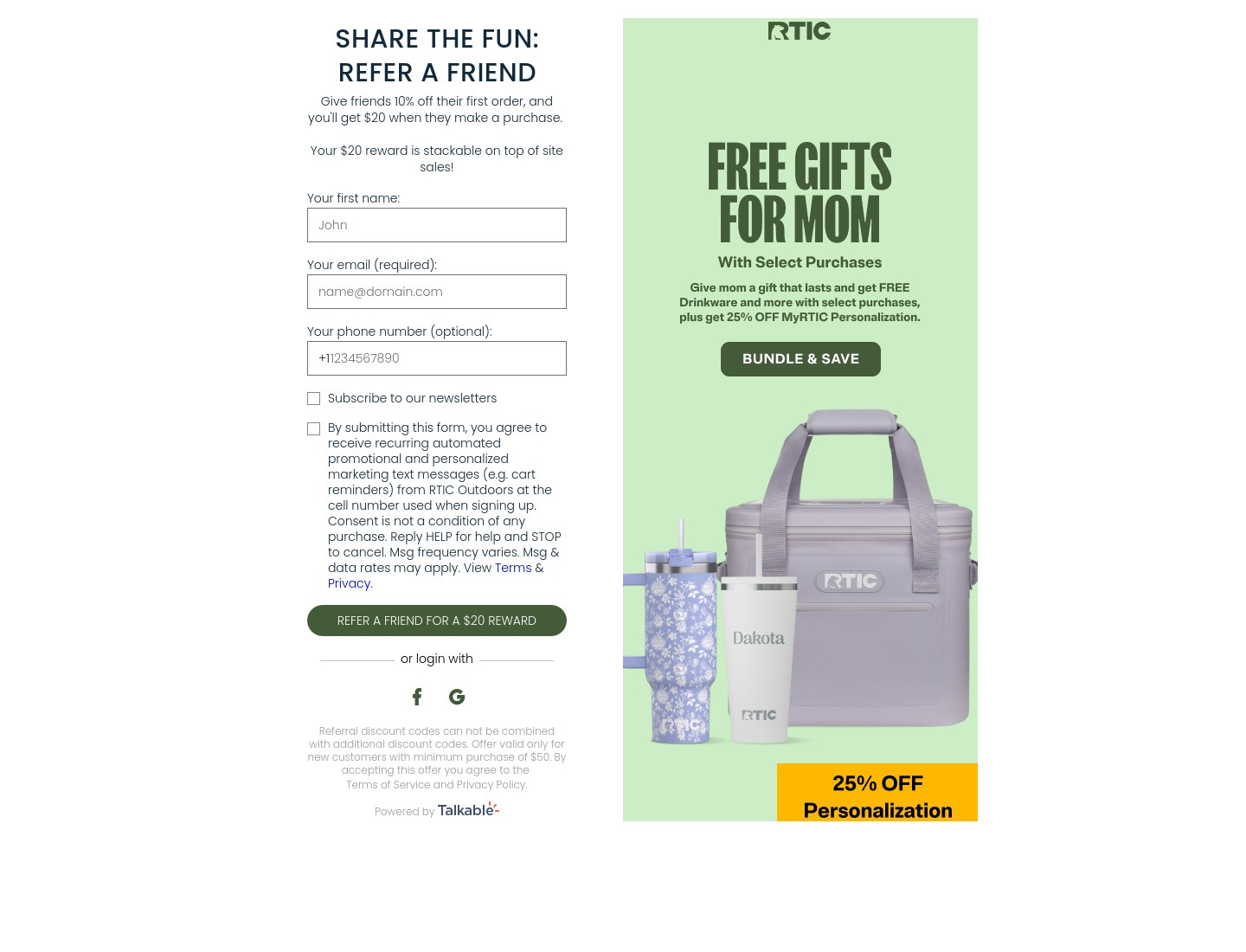
We spotted RTIC Outdoors running a live Mother’s Day referral campaign in Talkable, and it immediately stood out for the right reasons. It is simple. It is seasonal. It is easy to understand in a split second. Most important, it actually respects how people shop around gift-heavy holidays.
This is the kind of campaign that works because it does not try too hard. RTIC takes a proven referral structure, gives it a clear Mother’s Day angle, and keeps the value exchange strong on both sides.
Why this one works
RTIC did not reinvent the wheel here. Good. Seasonal referral campaigns usually perform better when the mechanics stay familiar and the framing does the heavy lifting.
The offer is balanced
The friend gets 10% off a first order. The advocate gets $20 off $100. That split makes sense. The first-time buyer gets a low-friction reason to convert. The existing customer gets a more meaningful reward for putting their name behind the brand.
The creative stays on-brand
A lot of seasonal referral campaigns get weird fast. Suddenly the brand voice disappears. Everything turns pink. The product gets shoved into the background. RTIC did the opposite.
The campaign keeps the brand’s clean, outdoorsy, product-first feel intact. The Mother’s Day framing is there, but it does not hijack the experience. That matters. Seasonal creative should feel like a useful layer on top of the brand, not a costume.

The share experience stays clean and product-focused, with a straightforward referral message and a clear discount for first-time buyers.
The timing makes sense
According to the campaign details in Talkable, RTIC launched this Mother’s Day set on April 13. That gives the brand a decent runway to catch both planners and last-minute shoppers. For gift-driven holidays, that timing window matters a lot.
If you launch too early, the campaign gets ignored. Too late, and you miss the share window. This one feels right in the pocket.
It is a full campaign set, not a one-off page
Another thing we like here: RTIC did not stop at one landing page. The Mother’s Day campaign is structured as a proper set across the referral flow:
- Standalone landing page for invite traffic
- Post purchase popup to catch the share moment
- Account dashboard for logged-in advocates
- Ineligible flow so the experience still makes sense when someone does not qualify
That is what separates a real campaign strategy from a themed asset. The best seasonal referral programs do not just swap a headline. They carry the idea through the actual customer journey.
Early signal looks promising
Even in its early run, the standalone page was already showing traction inside Talkable. At the time we reviewed it, the campaign had generated:
- 183 impressions
- 29 shares
- 26 offer clicks
- 15 site visits
- 1 ideal friend sale worth $230
Those are still early numbers, but the shape is what you want to see. People are sharing. Recipients are clicking. Traffic is making it through. The funnel is alive.
What brands can steal from this
- Use the holiday as context, not as camouflage. The campaign should still feel like your brand.
- Keep the offer readable in one glance. If people need to decode it, you already lost.
- Build the full flow. Landing page, share experience, post-purchase touchpoint, and fallback states all matter.
- Launch with enough runway. Gift holidays need time for people to share, browse, and convert.
Why we love it
RTIC’s Mother’s Day campaign is a good reminder that strong referral marketing does not need circus tricks. It just needs the right message, the right offer, and the discipline to keep the whole thing coherent.
That is what this campaign gets right. It feels timely without being cheesy. It feels useful without being over-discounted. And it keeps the referral mechanics dead simple.
For a seasonal campaign, that is kind of the whole game.
We’re collecting referral campaigns that actually know what they’re doing.
If you want to see how leading ecommerce brands are using referral programs around key seasonal moments, let’s talk.
See Talkable in action