
















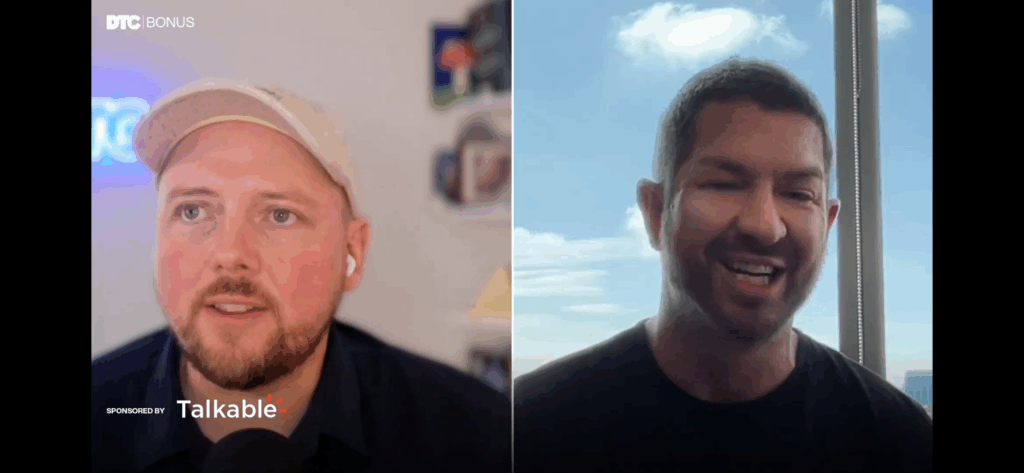
Talkable's Head of Marketing joined Eric Dyck on the DTC Podcast to talk about referral loops, CAC math, and why most brands are leaving one of their best growth channels untouched. Full interview at the bottom of the page.
Referral marketing is the most underestimated growth channel in DTC
Ad platforms cost more every year. Consumer trust keeps dropping. Budgets get tighter while targets don't, and nobody has patience for channels that don't perform. When the paid strategy that's kept you afloat starts eating into margins, you need somewhere else to look.
That's what I went on the DTC Podcast to talk about: how referral has become the most under-leveraged tool in most DTC stacks, and why that gap is finally closing.
This wasn't a conversation about minor optimizations. It was a case for rethinking how acquisition works from the ground up.
When the CAC math breaks down
We opened with a client story that tells the whole problem in one sentence. A DTC men's fashion brand was paying $500 to acquire a customer whose first purchase was worth only $275.
That's not a margin problem in isolation. That's a business model that doesn't work. And it's more common than most brands want to admit, because Meta and Google CPMs keep rising while the brands chasing those channels often don't see the floor dropping out until it's too late.
When this client launched a referral program with Talkable, acquisition cost on referred customers dropped to $1. The referred customers converted faster, bought again more often, and referred others in turn.
Referred customers consistently outperform paid-acquired customers on every metric that matters: conversion rate, repeat purchase rate, average order value. The trust that comes from a friend's recommendation does real work before the customer ever lands on your site. You're not starting from zero with a cold stranger. You're inheriting credibility.
What's changed since referral 1.0
Talkable ran the first post-purchase referral offer fifteen years ago. At the time, getting anything live on a thank-you page was genuinely new. Today, that's table stakes.
Customers shop across channels: on mobile, in stores, through social commerce. The brands winning with referral are meeting people where they already are, not just in their inbox waiting for an email to land.
That's why we built Talkable Wallet. Customers can store and share their referral code directly from their phone's wallet app, right next to their concert tickets and boarding passes. Picture this: someone compliments your shoes at a party, you double-click your lock screen, and your referral code is ready to share right there.
The referral moment has moved from the browser to real life. When it works in real life, the numbers show it.
1000+ ecommerce brands use Talkable to run referral programs that drive measurable revenue. We can show you real benchmarks from brands in your vertical.
Let's TalkWhat makes a referral program actually work
Referral marketing isn't magic. It's mechanics. Most programs underperform for predictable reasons: the offer is weak, the timing is off, or the message doesn't land with anyone.
The offer has to matter
Cash works. So does early access or product exclusivity. What doesn't work: a reward so small it signals you don't really value the referral. Worse is when a customer sends a friend a 20% off code, and that friend arrives at the site to find a 75% off banner at the top of the page. That tells the referrer they've just been made to look like a fool. Trust doesn't survive that.
The timing has to hit
The best moment to ask for a referral is right after the customer's peak of delight. Maybe it's the second they click "order." Maybe it's when the package lands on the porch. It is definitely not when the invoice shows up in their email. Brands that nail timing see significantly higher share rates than those running generic post-purchase sequences weeks after the fact.
The message has to feel real
People are tuned out to brand-speak. They've learned the language of referral programs and can spot a transactional ask immediately. The brands getting real referral behavior are the ones whose customers feel like they're sharing something they actually love, not forwarding a discount code because a triggered email told them to.
This is why Talkable doesn't hand clients a template and a login. We run segmentation, build the testing framework, manage pulse promotions, and sit in the planning calls. A configuration that works for a beauty brand won't work for a pet food subscription. The work is in the customization.
Common reasons referral programs underperform
- Asking for a referral before the customer has experienced the product
- Offering a reward too small to feel worth sharing
- Undercutting the referrer with a better public discount on-site
- Sending generic, mass-blast referral emails without segmentation
- Running referral as a one-time campaign instead of an always-on channel
- Treating it as a set-and-forget widget instead of a channel to actively optimize
Referral as a revenue engine
Most brands still treat referral like a widget. A static banner that says "give $10, get $10" that nobody on the team actively manages. One of the most under-leveraged growth tools in their stack, sitting there doing 20% of what it could.
Talkable has helped brands drive over $1.5 billion in first-purchase referral revenue. One DTC brand we've worked with since the early days has generated nearly half a billion dollars through its referral program alone. That's not a side channel. That's a core revenue driver.
For CFOs, the business case is simple: you pay only after a transaction happens. No wasted impressions, no click fraud, no spend on people who never convert. The customer who arrived via referral typically has a higher lifetime value, buys again more often, and is more likely to refer others. Every piece of the math points in the right direction.
For founders running lean: our team becomes your team. No added headcount, full referral program management from strategy through testing and reporting. We've worked this way with brands at every stage, from Series A to publicly traded.
The case for doing this now
If you're still reacquiring the same customers through paid channels every quarter, that cycle gets more expensive over time, not cheaper. CPMs don't go down. Platform fees don't go down. The brands that build referral as a channel now are the ones that will have the acquisition advantage in two years when everyone else is fighting over the same paid inventory.
Referral compounds in a way paid channels don't. Each referred customer who converts becomes a potential referrer themselves. Over time, a well-run program generates acquisition that paid media simply cannot replicate at the same cost basis.
If you don't have a referral program, Talkable can build it. If you have one that isn't getting traction, we can find out why. And if you want to take the referral moment beyond the browser, Talkable Wallet is already doing that for brands today.
Watch the full DTC Podcast interview below.
Want to see what a referral program looks like for your brand specifically? Book a 30-minute call with the Talkable team. Real numbers, real benchmarks, no pitch deck.
About the Author
Jeremy Foreshew is Head of Marketing at Talkable. He works with DTC and eCommerce brands on referral strategy, retention, and customer-led growth. He has been featured in Forbes, TechCrunch, and HuffPost.