

















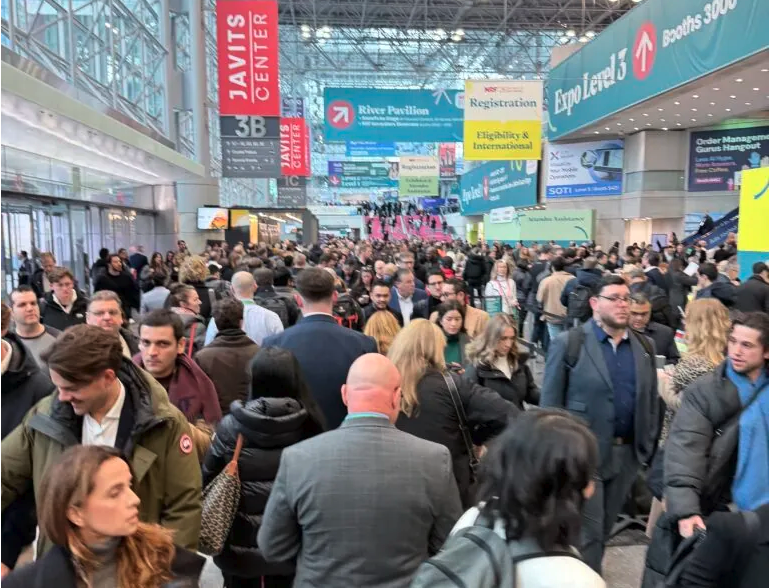
I'll be honest: after three days at NRF in New York, my feet hurt and I've had more coffee than I should have. But that's kind of the point. Retail's Big Show throws 40,000+ people into the Javits Center and basically says "figure out the future." This year's theme was "The Next Now," which sounds like marketing fluff until you actually walk the floor and realize, yeah, the next now is already here.
Here's what stuck with me.
Agentic Commerce Is No Longer a "What If"
The biggest moment of the show? Google CEO Sundar Pichai taking the stage Sunday morning to announce the Universal Commerce Protocol. If you haven't been following this space, here's the short version: AI agents are about to start shopping for us. Like, actually completing purchases. And Google just created the standard that lets that happen across the industry.
Who was already on board? Walmart, Shopify, Target, Etsy, and Wayfair helped build it. Home Depot, Best Buy, Macy's, Mastercard, and Visa endorsed it at launch. Walmart's incoming CEO John Furner was literally on stage with Pichai announcing that you'll soon be able to buy Walmart products directly inside Google's Gemini AI. No clicking through to a website. Just conversation to purchase.
Everyone's Talking About AI, But the Smart Ones Are Talking About People
Here's what I didn't expect: for all the AI hype, the most memorable sessions were about humans. Ed Stack from Dick's Sporting Goods said it plainly: "Right now, we're looking at AI really as a productivity tool more than a replacement of personnel." Not exactly a hot take, but hearing it from someone running a $13 billion company carries weight.
REI's CEO Mary Beth Laughton went further. She argued that AI will become table stakes for everyone, so it won't be a differentiator. What will set brands apart? "The human connection point. AI can be really fast. It can be really effective. It's super smart. But the thing it can't do is that lived experience."
REI is already acting on this. They're featuring their "green vest" store associates (the ones who actually use the gear) in product page testimonials and videos. And it's working. Laughton said they're seeing a real lift in conversions. Turns out people still trust other people more than algorithms. Not a surprise to anyone in the referral marketing business.
Your best advocates aren't bots. They're customers who genuinely love what you sell. That hasn't changed, and I don't think it will.
Own the Relationship or Lose the Customer
One thing Google was very clear about with UCP: even when AI handles a transaction, the retailer stays the merchant of record. The brand still owns the customer relationship. That's not an accident. It's a strategic choice, and it tells you where value will live in this new world.
Laughton at REI is already thinking about this defensively. She mentioned they're careful about "what is special that we want to keep just for our own platforms, and what can show up on one of those LLMs." Smart. Because once you let an intermediary own your customer relationship, good luck getting it back.
This is why referral programs matter more than ever. When a customer refers a friend, they're not just driving a transaction. They're creating a relationship that starts with trust. That friend doesn't show up as an anonymous click from an AI agent. They show up because someone they know vouched for you. That's a fundamentally different starting point, and it's one that no algorithm can replicate.
1000+ ecommerce brands use Talkable to run referral programs that drive measurable revenue. We can show you real benchmarks from brands in your vertical.
Let's TalkThe 'Do Everything' Era Is Over
This wasn't the sexiest theme at NRF, but it might be the most important: focus matters again. Multiple speakers hit on the idea that chasing every shiny object is a losing strategy. The winners in 2026 will be the brands that know exactly who they serve and ruthlessly optimize for that.
There was a lot of talk about eliminating friction. Manual processes, bad data, reconciliation errors. Every time a human has to touch something a machine could handle, you're losing money. Gartner projects that 40% of enterprise apps will have task-specific AI agents by the end of 2026. That's not a far-off prediction. That's this year.
Stores Are Becoming Everything
Here's a stat that surprised me: Dick's Sporting Goods now fulfills 80% of their online orders from stores. The physical location isn't just a showroom anymore. It's a fulfillment hub, an experience center, and apparently still a place people genuinely want to be.
And then there's drone delivery. Google announced they're expanding Wing drone delivery with Walmart to 150 stores, reaching 40+ million Americans. We're not talking about pilot programs anymore.
The upshot for referral marketing? Omnichannel isn't a buzzword. It's the reality. If your program can't track a referral that starts on Instagram, continues in-store, and converts via a drone-delivered same-day purchase, you've got some work to do. We all do.
The Bottom Line
Walking out of the Javits Center, I kept coming back to one thought. All this technology, all these AI agents and protocols and drone deliveries, they're going to make shopping more convenient. No question. But they don't change the fundamental thing that makes referral marketing work: people trust people.
When your friend tells you a product is great, that means something an algorithm can't replicate. The tools are evolving fast. The underlying physics of word-of-mouth? Still the same.
If you're thinking about how all this affects your referral strategy, that's literally what we do at Talkable. Let's talk.
Jeremy Foreshew is Head of Marketing at Talkable, where he helps DTC and eCommerce brands turn their customers into their most powerful acquisition channel. He has been featured in Forbes, TechCrunch, and HuffPost.