

















Inspiration and planning patterns for marketers who need concrete, evidence-conscious campaign ideas.
Use examples as patterns, not templates to copy
Wallet pass campaigns are easy to admire from a screenshot and hard to operate from a screenshot. A polished pass tells you little about who received it, what data drove the fields, whether a barcode worked, or how the team handled exceptions. The useful way to study examples is to identify the customer job, the trigger, the information shown, the action expected, and the operational dependency behind it.
The campaign patterns below are deliberately not presented as performance promises. They are planning prompts. A brand should validate each pattern against its own commerce flow, audience, fulfillment rules, legal requirements, and measurement capability before building it.
Example pattern: post-purchase membership card
After a customer enrolls in a loyalty program or completes a qualifying purchase, invite them to save a member pass from a confirmation page or account email. The pass can display an existing member identifier and a short explanation of where it is useful. The customer action is simple: save it now so identification is easier later.
This pattern is strongest when the identifier already has a real use, such as an in-store scan or a support lookup. It is weak when the card is decorative and offers no practical next step. Before launch, test account matching, barcode behavior where applicable, device replacement, and the language support will use when an ID cannot be recognized.
Example pattern: an earned reward with a clear deadline
When a customer has a verified reward, a pass can surface the reward amount or description, the expiration date if one exists, and the redemption route. The campaign trigger is the verified entitlement, not a hopeful prediction. The pass helps the customer find the benefit when they are ready to shop or present it.
The risk is vague redemption. If a reward works online only, say so. If it requires an authenticated account or cannot stack with another discount, make the immediate limitation easy to find and link to full terms. Test expiration logic and timezone handling. A date that differs between a pass and checkout damages confidence quickly.
Example pattern: referral status and available credit
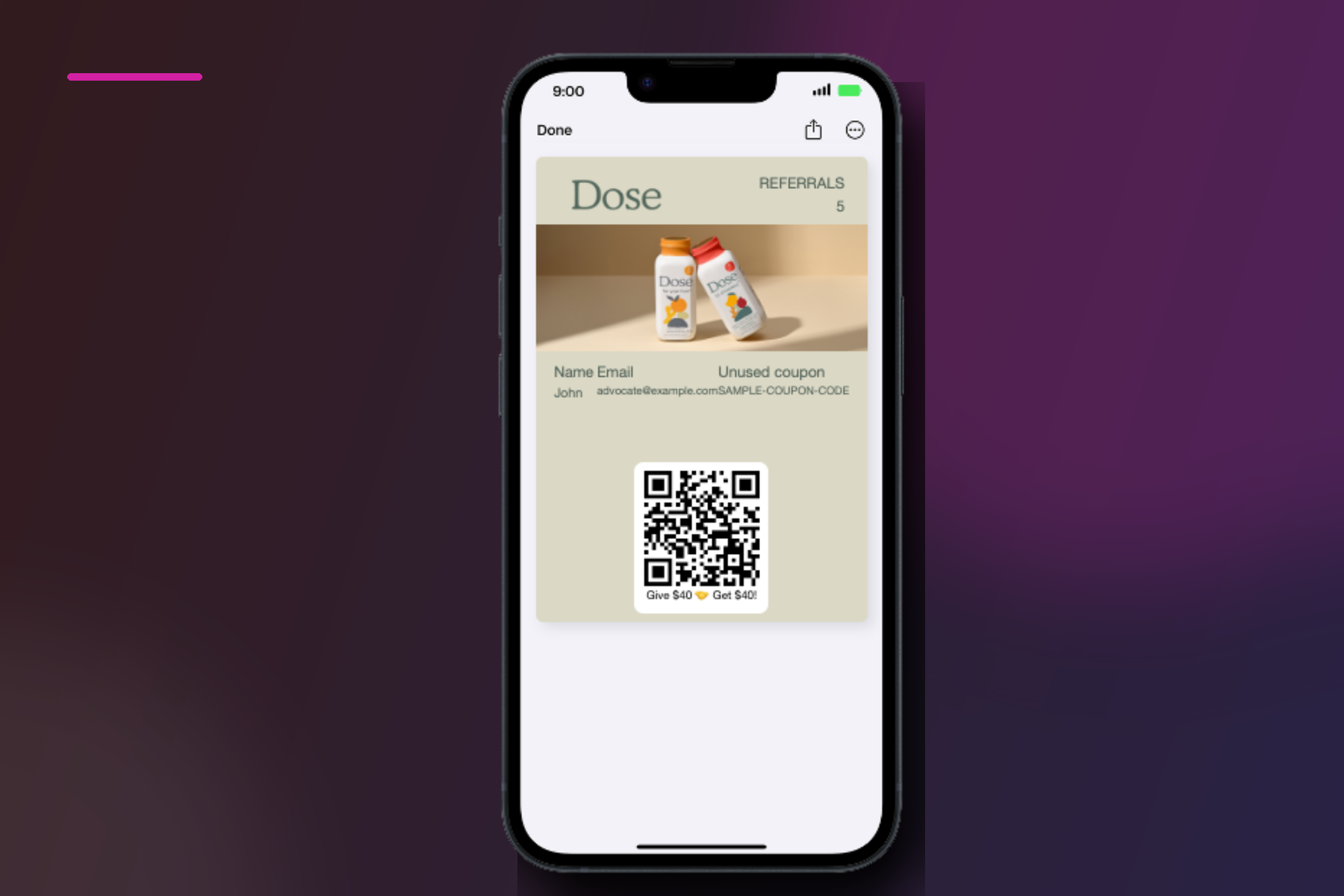
For referral programs, invite advocates to save a pass after they enroll or once a reward becomes available. A mature version can show an honest status, a route to share again, and a way to redeem a verified reward. This gives the advocate a dedicated place to revisit a program that otherwise lives across several emails and web pages.
The critical dependency is state accuracy. Pending referral validation is not available credit. Reversed orders may affect a reward. Duplicate checks may hold an event. Build the status vocabulary and support process before the creative. The campaign becomes credible when the pass says exactly what the program can substantiate.
Example pattern: local event, pop-up, or appointment utility
A retailer with a pop-up, class, appointment, or limited local activation can use a pass as a utility object. It may show time, location, entry details, or a scannable identifier if the onsite process supports it. The campaign is not primarily about pushing a sale. It removes friction for someone who has already chosen to attend.
This pattern requires close coordination with the event operator. Confirm staff instructions, scanning equipment, backup check-in, accessibility information, changes to schedule, and customer communications if the location changes. The pass should link to current details rather than freeze a complicated itinerary into a small layout.
Example pattern: a replenishment or service reminder
For products or services with an expected return cycle, a pass can be tied to a customer-facing reminder only when the timing is grounded in the customer’s actual context. The pass might show the last relevant purchase date, an eligible benefit, or a link to reorder. Do not imply that a customer needs a product on a schedule unless the brand can support that recommendation responsibly.
Use this pattern cautiously with sensitive categories. Privacy, suitability, and consent concerns can outweigh convenience. Keep pass content minimal and avoid displaying information a customer would not want visible on a lock screen or to a nearby person.
Turn an example into a testable campaign brief
Test the operating reality
For each candidate pattern, write a one-page brief: audience, trigger, customer job, pass fields, data source, customer action, terms, failure states, support owner, and measurement plan. Then walk a test account through the exact route. Ask what happens if the offer expires, the data feed pauses, the customer has two accounts, or a store associate cannot scan the code. These questions reveal whether the campaign is a concept or an operating experience.
Choose one campaign with a modest dependency footprint. A member ID or verified reward is usually simpler than a dynamic, multi-system promotion. Keep a record of what customers actually do and what they ask. The examples that matter most are the ones that become more useful after real-world feedback, not the ones that look clever in a planning deck.
There is another pattern worth considering in any category with a physical redemption point: a store or service visit pass. The pass can hold a member identifier, appointment confirmation, or a concise benefit that staff understand. Its value comes from removing a lookup or paper handoff. It should not be launched until the operational team has seen the visual and knows what to do when scanning fails.
Make the invitation earn attention
Campaign timing matters. A post-purchase invite has a different meaning from a broad promotional placement. After a customer receives a verified reward, saving a pass is an offer of convenience. During a seasonal campaign, a pass could look like another message competing for attention. Decide whether the customer already has a reason to save it. If not, improve the proposition rather than increasing invitation frequency.
Use copy that names the utility. Save your reward for checkout tells a customer more than a generic Wallet prompt. Keep your event entry details handy sets the same expectation for a local activation. If the benefit will not be usable until a later date or subject to approval, say that plainly. A clear limitation creates fewer support contacts than a cheerful ambiguity.
A creative concept needs a content expiry plan as well as an offer expiry plan. Seasonal artwork may be appropriate for a limited event, but it can make a pass look obsolete afterward. Decide whether the pass will transition to an evergreen member card, be retired, or update to the next relevant status. Do not leave customers with a dead campaign object that has no explanation.
Measure the pass on its own job
In campaign reviews, separate the performance of the offer from the performance of the pass. A weak offer may not become strong because it appears in Wallet. A good offer may work through several channels. Measure whether the pass changed access to the offer, reduced customer effort, or clarified a status. That is a more defensible question than claiming it created every resulting order.
Finally, collect examples from your own customer support queue. The best next campaign is often implied by a repeated question: Where is my reward? Can I use this in store? What time does my appointment start? A Wallet pass can be appropriate when it provides a concise, dependable answer. When it cannot, a clearer email or account page may be the better campaign asset.
Plan for the campaign to end
Build campaign readiness around evidence, not excitement. For each proposed pass, identify the existing system that supplies the member ID, reward status, event detail, or offer rule. Identify the person who can correct an error. Identify the customer action that proves the pass was useful. If any answer is missing, use a simpler channel until the dependency is ready. A campaign calendar does not make an incomplete data flow safer.
Let the campaign end gracefully. When an offer is redeemed or an event has passed, a customer should see a final, comprehensible state or a route to a relevant evergreen experience. Do not leave an old pass with a bright call to action that leads to an expired page. Review this behavior during creative approval, not after the campaign is live.
Use controlled comparisons only where they are ethical and practical. An eligible group that receives an invitation can be compared with a similar eligible group that does not, but interpretation still needs caution. Customers may be different in ways the data cannot show. Treat directional evidence as directional. Pair it with customer feedback and support data before declaring a campaign pattern successful.
There is value in stopping a pattern that does not help. If a pass invitation adds confusion, support volume, or stale information, remove it and preserve what you learned. That is better than keeping a neglected pass alive because it took effort to build. Ecommerce teams earn customer trust by making fewer promises and keeping the useful ones current. A final readiness check should include customer-facing copy, source-data confirmation, expected expiry behavior, and a support owner. If the team cannot test the complete loop, it cannot yet promise the experience. Review that checklist with the people who answer customer questions and operate redemption. Their feedback will often surface the missing detail before a campaign exposes it to a customer. Keep the first version narrow, record the exceptions, and change the next version only after the operating team understands what occurred. Document those findings.
| Campaign pattern | Customer job | Key dependency |
|---|---|---|
| Member pass | Identify membership quickly | Reliable member ID |
| Earned reward | Find and redeem a verified benefit | Accurate eligibility and expiry |
| Referral status | Understand reward progress | Referral state model |
| Event utility | Access current event details | Onsite process and updates |
| Replenishment reminder | Return to a relevant purchase path | Context, consent, and privacy review |
Build the customer journey first. A pass should make one useful action easier, not become another place for marketing copy to pile up.
See how Wallet fits into referral marketing
Talkable helps ecommerce teams connect referral programs, rewards, and customer moments that are worth returning to.
Let's TalkQuestions ecommerce teams ask
Can these campaign patterns work for any ecommerce brand?
No. Each depends on a real customer job and dependable program operations. Use the patterns to frame discovery, not as a promise that every brand should launch every one.
Which pattern is safest for a first test?
A member identifier or a verified, existing reward is often simpler because the customer value and data source are easier to define. Validate your own systems first.
Should a pass campaign replace email?
No. Email, web, and Wallet can have different jobs. Use the pass for concise, easy-to-find information and link to fuller detail where needed.
What should be on a campaign pass?
Include only information that helps the customer act now, such as a verified status, relevant expiry, identifier, or direct route to the next step.
How can a team avoid stale pass information?
Name a source of truth for each field, define update triggers, test failures, and give support a way to see the same program state.