

















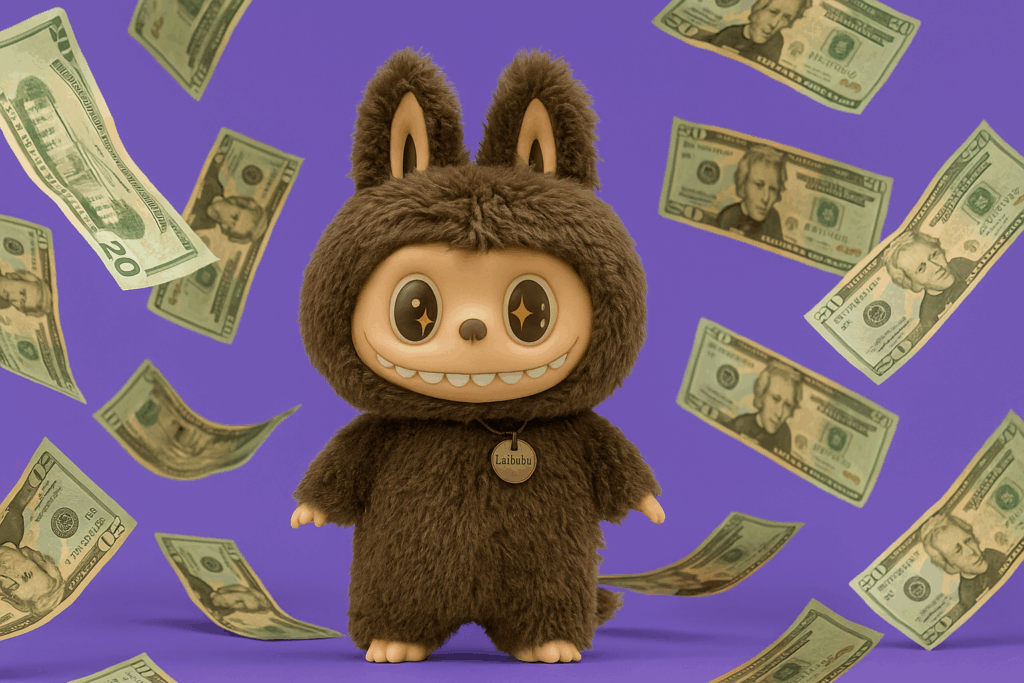
How a bug-eyed gremlin from Hong Kong, one BLACKPINK Instagram post, and the dopamine thrill of mystery boxes created the year's most talked-about viral loop. And what DTC brands can actually do about it.
The scene outside the toy shop
Cold Saturday in London. A queue snakes around Pop Mart's Soho flagship. Someone brought a camp chair. Another came with bodyguards. One unlucky fan ends up in a TikTok clip titled "Labubu Line Brawl" before security shuts the doors. Pop Mart pauses in-store sales nationwide, citing "safety concerns."
Why the frenzy? Because a bug-eyed gremlin called Labubu has become this year's must-have accessory: part plushie, part social flex. Similar scenes played out in Chicago, Dubai, and Bangkok. Hype, it turns out, travels faster than cargo.
Pop Mart crossed $1.8 billion in revenue in 2024. It wasn't driven by ad spend. It was driven by people telling other people.
How a K-pop superstar lit the fuse
The tipping point came when Lisa (BLACKPINK) posted a late-night Instagram dump: one slide of matcha, one of her cat, and smack in the middle, a shelf packed with Labubus. Within hours the "ugly-cute" elf was trending across fan Twitter and Weibo. Retailers sold out. Resellers listed mystery boxes at ten times retail.
Lisa's post had a cascade effect. Dua Lipa wore a Labubu bag charm in Paris. Rihanna was photographed in New York clutching the Skeleton Labubu. Filipino TV host Vice Ganda showed her blind-box haul live on air. None of it was paid. None of it was coordinated. It happened because the product gave people something worth showing off.
The hashtag #labubu now has over 1.4 million posts on TikTok: unboxings, counterfeit warnings, skits about Labubu "ruining" relationships by stealing rent money. The content keeps multiplying because every purchase creates a new reason to post.
The unboxing ritual
Labubu figures come in blind boxes. You don't know which one you're getting. That turns every purchase into a gamble, and every reveal into content worth filming.
Beau Dunn posted a glam reel opening a Labubu on her marble kitchen island. Bella, a toy collector from the Philippines, revealed her pull in front of a wall of unopened Pop Mart boxes. Food influencer Raina Huang tore hers open with the same drama she brings to mukbangs. Each post pulls new fans into the fold.
The ritual works because the reveal is the reward. You're not just buying a toy. You're buying a moment. And moments get filmed.
This is why content keeps spreading without any promotion from Pop Mart. The product design does the work. Every unboxing is an ad. Every "I got the rare one!" post is a recommendation. Pop Mart built a sharing mechanism into the purchase itself.
@lm_0327
1000+ ecommerce brands use Talkable to run referral programs that drive measurable revenue. We can show you real benchmarks from brands in your vertical.
Let's TalkThree things Labubu does that most DTC brands don't
It creates something worth showing off
Labubu isn't pretty in a conventional sense. That's the point. The "ugly-cute" design is distinctive enough that people want to display it, photograph it, and argue about it. It has shelf presence. It has personality.
Most DTC brands spend enormous energy on product photography and then forget that customers also need a reason to show the product off in real life. That reason doesn't have to be a limited edition colorway. It can be the packaging, an insert card, a unique unboxing experience. Something that makes the customer feel like they got something special enough to share.
The scarcity is real, not manufactured
Pop Mart releases new Labubu series in limited runs. The "secret" figures (rarer variants hidden in each series) appear roughly once in every 72 boxes. That ratio is published. Collectors know it. They hunt for it.
This is different from slapping "limited quantities" on a product page as a conversion tactic. Pop Mart actually limits production. That creates genuine competition for the product, which drives both purchase urgency and social comparison. If your friend pulled the secret figure and you didn't, that's a story that gets told.
The brand lets fans do the creative work
Pop Mart doesn't try to control how Labubu gets represented online. Fans make art, cosplay, memes, custom restorations. Some of the most viral Labubu content has nothing to do with Pop Mart as a company. The brand is confident enough in the product to let fans run with it. Fan content outnumbers brand content by a wide margin, and that's exactly how they'd want it.
What you can steal from this
Pop Mart is a toy company with a very specific product mechanic. Most DTC brands aren't selling blind boxes. But the underlying dynamics are reproducible.
Actionable takeaways for DTC brands
- Make the reveal shareable. Your packaging, unboxing, and post-purchase moment should be something customers want to film. An insert card that says "tag us" isn't enough. The moment itself has to earn the post.
- Give your best customers status, not just discounts. Referrers and loyalists should feel like insiders. Early access, exclusive variants, handwritten notes: things that cost little but signal that someone matters to you.
- Time your referral ask to the peak of delight. Not the invoice. Not the shipping confirmation. Right after delivery, when the box is on the table and the excitement is real. That's when share rates are highest.
- Let fans run with it. Don't over-script UGC. The brands that try to control every piece of customer content end up with content that looks controlled. Authenticity doesn't survive editing.
Where referral programs fit in
The most powerful growth channel for any DTC brand isn't the ad budget. It's the fans talking about you when you're not in the room.
Glossier, Skims, Liquid Death, Pop Mart: each rode to scale on word of mouth. Some of that was organic and untraceable. Some of it can be systematized with the right referral program. The two aren't mutually exclusive.
What referral programs do is capture the advocacy that would have happened anyway, and make it measurable. They give happy customers a reason to share sooner, and a mechanism to share more easily. They don't manufacture enthusiasm that isn't there. They give existing enthusiasm somewhere to go.
When someone name-drops your brand in a group chat, or tags a friend in an unboxing video, or walks into a party wearing something that makes people ask questions: that's distribution money can't buy. A referral marketing strategy extends that moment. It gives it structure.
The mistake most brands make is assuming referrals only count if they're tracked. The value of word-of-mouth is much bigger than what shows up in your attribution dashboard. But the tracked portion, the formal referral program, is where you can actually optimize, test, and compound results over time.
Labubu didn't invent word-of-mouth. It just executed every part of it better than almost anyone else in recent memory. The queue outside the Soho store wasn't an accident. It was what happens when a product gives people a reason to talk, something worth showing off, and a community to belong to.
Most DTC brands have happier customers than they realize. The gap is usually in what happens after the purchase. A well-built referral program doesn't create advocates. It finds the ones you already have.
About the Author
Jeremy Foreshew is Head of Marketing at Talkable. He works with DTC and eCommerce brands on referral strategy, retention, and customer-led growth. He has been featured in Forbes, TechCrunch, and HuffPost.