













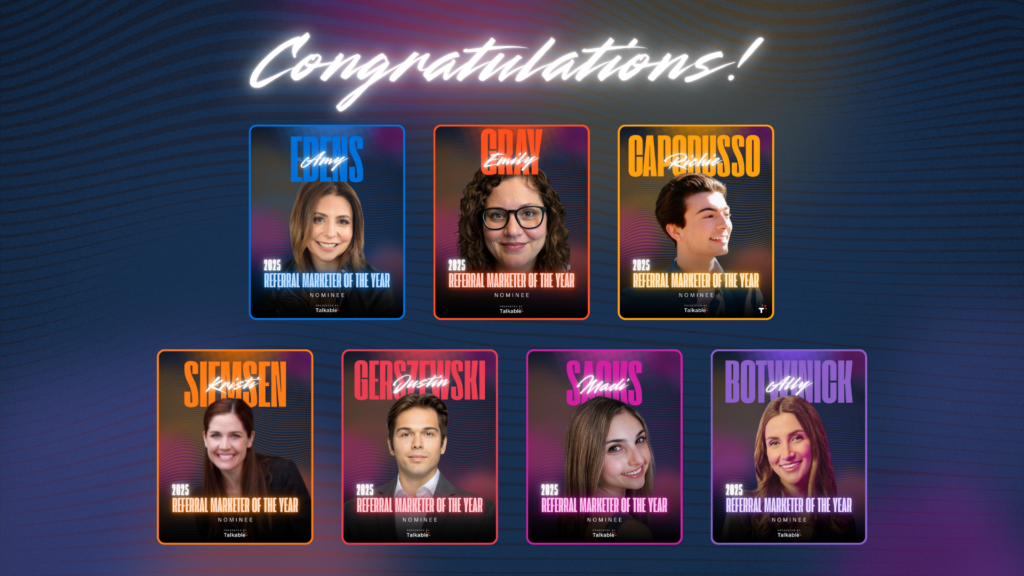
Every brand says they want word-of-mouth growth. These seven marketers actually built it.
We created the Referral Marketer of the Year award because the people doing the most interesting work in referral marketing rarely get recognized for it. Your paid acquisition team gets the credit when CAC drops. Your email team gets credit for open rates. But the person who quietly turned your best customers into your best salespeople? That work tends to go unnoticed.
Not anymore. We looked at referral programs across our client base, evaluated 2024 performance, and identified seven marketers whose work genuinely raised the bar. These are not simply the marketers with the highest-traffic programs. These are the marketers who showed the sharpest thinking.
Why This Award Exists
Most referral programs are mediocre. They launch, nobody really notices, and the team moves on to the next thing. The ones that actually work are run by people who treat referral as a discipline, not a line item. They test. They iterate. They understand their customers well enough to know what motivates them to share, and they build toward that.
This award is for those people. The winner will be announced in early January, and we're proud of every name on this list.
The 2025 Nominees
Amy Edens — Nutrafol
Nutrafol operates in one of the more sensitive product categories in ecommerce: hair wellness. Women who find a product that actually works for them are motivated to share, but the share moment is delicate. You're essentially telling someone "this helped me with something I don't usually discuss openly." That requires trust, and programs that ignore that dynamic tend to feel awkward to advocates.
Amy built a program that honors how Nutrafol customers actually think about sharing. The creative doesn't oversell. The reward structure is generous without feeling transactional. And the program surfaces at the right moments in the customer journey, not just once at post-purchase and never again. What impresses us most is the patience behind it. Good referral in wellness categories is a slow build, and Amy clearly understands that.
Ally Botwinick — Alo Yoga
Alo Yoga has a customer base already motivated to share. Strong community, aspirational brand, a social following that most companies spend years trying to build. The easy move is to coast on that organic momentum with a standard discount structure and call it a referral program.
“When your brand has strong organic word-of-mouth, the temptation is to not mess with it. The better instinct is to build something worthy of it.”
Ally didn't settle. She built a program with creative direction sharp enough to match Alo's brand equity, a reward structure designed to drive repeat advocacy rather than one-time shares, and placement that captures the specific moments when Alo customers are most inclined to tell friends about the brand. That's genuinely harder than it sounds.
Kristi Siemsen — American Eagle Outfitters
Running referral at AEO's scale is a different problem than running it at a boutique DTC brand. The coordination required across marketing, technology, and customer experience teams is genuinely complex. Attribution is harder. Testing cycles are slower. What works for a 50,000-customer brand doesn't directly translate to a retailer with millions of customers across multiple channels.
Kristi built something that works at that scale. The program integrates cleanly with AEO's broader loyalty ecosystem, the reward economics make sense across their SKU range, and the attribution holds up. That last point matters more than people realize. Many large brands technically have referral programs that can't demonstrate ROI. Kristi built one that can.
Madi Sacks — Seed
Seed's customer proposition is built on education. The probiotics category is complicated, the science is real, and customers who genuinely understand how Seed's products work become passionate advocates. That's a real asset for referral marketing, but only if you build a program that takes advantage of it.
Madi did. Seed's referral experience matches the brand's tone: smart, direct, no artificial urgency. The program activates customers at peak satisfaction, and the share mechanics make it easy to pass along the same educational framing that convinced the advocate in the first place. That continuity of message is rare and effective.
Justin Gerszewski — Renue by Science
Renue by Science sells NAD+ supplements to a customer base that has done serious research before buying. These are people who've read the science, weighed the options, and chose Renue deliberately. That customer profile is referral gold, but you have to approach them right. They're not motivated primarily by discounts. They're motivated by confidence that their recommendation will hold up.
Justin built a program that respects that self-image. The offer structure doesn't lean on aggressive discounting. The messaging treats advocates like the informed buyers they are. For a brand this specialized, getting referral right requires a deep understanding of customer psychology, and Justin has that understanding.
Richie Caporusso — 3Z Brands
3Z Brands operates several mattress and sleep brands, which puts them in a purchase cycle that breaks most referral logic. Mattresses are a high-consideration, infrequent buy. The typical "refer a friend within 30 days" mechanic falls apart when your customer just bought something they'll use for a decade.
Richie built programs across the 3Z portfolio that account for this. Advocates earn rewards when referrals convert on the friend's timeline, not the brand's. Visibility doesn't disappear weeks after the initial purchase. Running this across multiple brands simultaneously, with coherent logic and clean attribution, is not a small operational lift. It's the kind of work that tends to be invisible until you understand what's required to pull it off.
Emily Gray — The CE Shop
The CE Shop offers online licensing courses for real estate professionals. Their referral opportunity is genuinely strong: students who pass their exam want their study partner to pass too. But timing matters here more than in almost any other category.
“The CE Shop's customer is a working adult who just spent months studying under real pressure. Emily built a program that respects that, and the results reflect it.”
Emily built a program that activates at exactly the right moment, when a student is feeling confident after completing a milestone rather than anxious mid-course. The mechanics are simple enough to convert even in high-stress periods. It's easy to overlook how much thought goes into activation timing in education-focused referral programs. Emily didn't overlook it.
What These Nominees Have in Common
Seven nominees. Seven different product categories. Seven different customer types. The surface differences are obvious.
What connects them is harder to articulate until you look closely. All of them treat referral as a real acquisition channel, not a nice-to-have running in the background on autopilot. All of them understand their customers well enough to build programs that feel right for those specific people. That's where most referral programs fail. The program that works for a NAD+ supplement brand will not work for an athleisure brand. Trying to force a one-size-fits-all approach is how you end up with a program that technically exists and generates nothing.
These seven didn't take that shortcut. If you want to understand what building a program at this level actually requires, our referral marketing guide is a good starting point, and our case studies show what results look like in practice.
1000+ ecommerce brands use Talkable to run referral programs that drive measurable revenue. We can show you real benchmarks from brands in your vertical.
Let's TalkAnnouncing the Winner in January
The winner of Talkable's 2025 Referral Marketer of the Year will be announced in early January. Congratulations to all seven nominees. You've raised the bar for what referral programs can achieve, and we're proud to work with each of you.
If your referral program could use that same level of attention and you're not sure where to start, let's talk. We've worked with enough brands to know what separates a program that performs from one that doesn't.