

















The best referral programs don't just offer discounts. They extend the brand experience, turning satisfied customers into authentic advocates who genuinely want to share.
This month, we're spotlighting three brands that prove referral marketing works across very different categories: CBD wellness, outdoor gear, and competitive swim equipment. What connects them is not industry. It's execution. Each program is built around how their customers naturally share, when they share, and why they share. That specificity is why they work.
From Five CBD's street art aesthetic to RTIC's adventure-first messaging to SwimOutlet's social proof-led design, these programs feel less like marketing tactics bolted onto a checkout page and more like natural extensions of how these customers already behave. Let's break down what's actually happening under the hood.
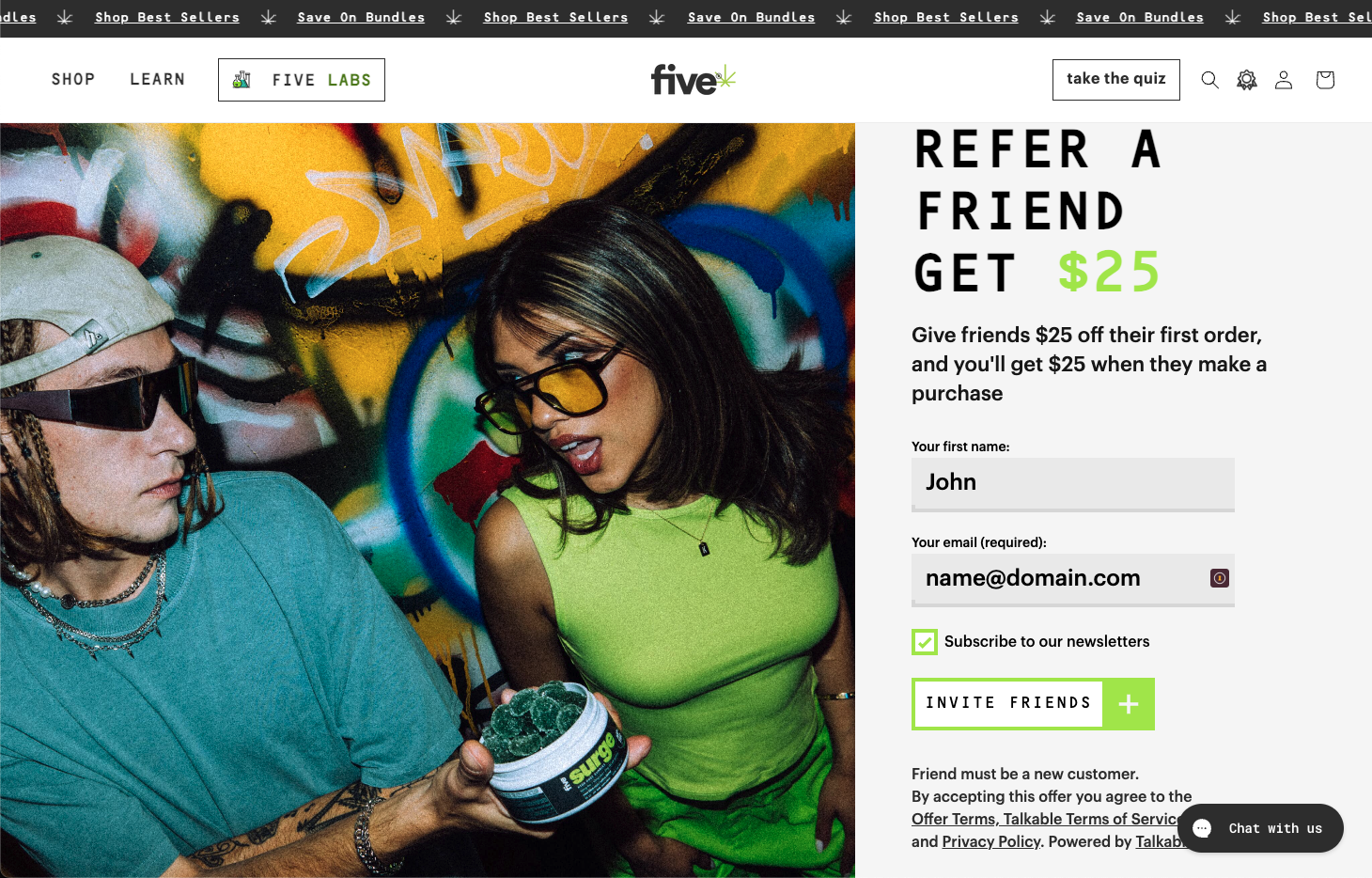
Five CBD: When Your Creative Does the Selling
Five CBD operates in a crowded, advertising-restricted category where most brands default to minimalist aesthetics and cautious language. Five did the opposite. Their referral program is built around vibrant, graffiti-inspired visuals and neon green accents that instantly communicate who they are and who they're for: younger, bold, unapologetic.
“The creative alone tells you this isn't your grandmother's CBD brand. That clarity of identity is exactly what makes sharing feel natural.”
What Makes It Work
The symmetrical $25/$25 offer is a deliberate choice. In wellness categories where trust matters above almost everything else, giving the advocate and their friend identical value removes any guilt around "selling" to someone you care about. You're not handing a friend a coupon because you want $10 back. You're sharing something you actually like, and they get rewarded equally for trying it.
Four distinct sharing methods (SMS, email, link, and name-based sharing) remove any excuse not to share. Whether your customer prefers a quick text or wants to drop a link in their group chat, Five has an option for them. That kind of friction reduction matters more than most brands realize.
What impresses us most is the mobile execution. These are clean, thumb-friendly layouts with clear hierarchy, built for how people actually share today, not retrofitted from a desktop template. In a category where advertising restrictions push brands toward word-of-mouth as a primary channel, Five built a program that actually earns those shares rather than just hoping for them.
The Strategic Angle
In CBD, advertising restrictions on Google and Meta have made word-of-mouth not just helpful but necessary. Five's response to that constraint is smart: make the referral program so on-brand that sharing it feels like an expression of identity, not a transaction. An advocate sharing Five's referral link is saying something about their taste. That's far more powerful than a generic "get $25 off" email.
RTIC Outdoors: Sell the Adventure, Not the Discount
RTIC's program understands something fundamental about outdoor gear buyers: people don't buy coolers. They buy into the idea of the next trip. "Share the Fun: Refer a Friend" is about bringing your crew along, not saving $20. That framing changes everything about how advocates feel when they share.
What Makes It Work
The asymmetric reward structure is well thought out. The 10% friend discount lowers the barrier to a first purchase on products with real average order values, while the $20 advocate credit feels meaningful rather than symbolic, especially when it stacks with existing sales. This structure also reflects something true about outdoor gear buyers: they care more about giving their friend a good deal than maximizing their own payout.
“"Your Friend John Smith Sent You 10% Off" does more work than any subject line A/B test ever will. The personal attribution is the headline.”
The custom message field is where RTIC's program really separates itself. Letting advocates write something personal ("Dude, remember that camping trip? Get one of these") transforms a discount code into a genuine recommendation. Generic referral emails get ignored. Something from a friend, in their voice, with their specific context? That actually gets read.
The friend landing page also places new product arrivals below the referral offer. Every referral becomes a discovery moment for current inventory rather than clearance stock. That's a small detail with a meaningful revenue impact.
The Strategic Angle
RTIC competes in a category dominated by Yeti's premium positioning. Rather than trying to out-premium the incumbent, their referral program doubles down on community and shared experience. RTIC customers are gear collectors building an outdoor ecosystem across multiple purchases. Every referral isn't just acquiring a new customer. It's expanding someone's RTIC collection and their sense of belonging to a particular kind of outdoors person. That's a more durable competitive advantage than price.
SwimOutlet: Social Proof as the First Thing You See
SwimOutlet's program doesn't start with the incentive. It starts with a number: 28,729 people have already shared. That number isn't buried in fine print. It's front and center, the very first thing a potential advocate sees. Before you even read how the program works, you understand that it works, because nearly 29,000 other people decided it was worth their time.
What Makes It Work
SwimOutlet shoppers buy seasonally. Back to school, new season gear, equipment replacements. They are not buying weekly. So a referral reward sitting in a marketing email from three months ago is effectively invisible by the time they're ready to buy again. Talkable Wallet integration solves this problem directly: rewards live in the customer's Apple or Google Wallet, where they'll actually encounter them when they open their phone months later. This is the right solution for a category with extended purchase cycles, and more brands should be thinking about it this way.
Talkable Video Referrals add a layer of authenticity that discount codes can't match. Instead of sending a cold code, advocates record a personal video recommendation. "You just got a mystery gift from your friend" paired with a real face and voice is something people actually open and watch. It's the digital equivalent of a poolside recommendation from a teammate, which is exactly where SwimOutlet's customers already talk about gear.
“A checkbox that says 'Send my friends a reminder in 3 days' is a small thing. It's also a sign that SwimOutlet understands timing is the real friction, not motivation.”
The automated 3-day reminder option is an underrated feature. Your friend might not be shopping for goggles today. They might be next week. One well-timed reminder beats radio silence, and giving the advocate control over that timing rather than automating it blindly is the right instinct. Customer reviews placed directly below the referral mechanics reinforce that SwimOutlet delivers quality worth recommending, which gives advocates confidence that their referral won't backfire on them.
The Strategic Angle
Swimming is inherently communal. Swim teams, swim parents, masters programs, triathletes. These people exist in tight groups where gear recommendations travel fast and carry real weight. The best swim store isn't the cheapest option; it's the one everyone in your lane swears by. SwimOutlet's program is built to activate those existing conversations, not to manufacture new ones. Talkable Wallet and Video Referrals keep SwimOutlet present in the moments when those poolside conversations actually happen.
1000+ ecommerce brands use Talkable to run referral programs that drive measurable revenue. We can show you real benchmarks from brands in your vertical.
Let's TalkWhat You Can Take From These Three Programs
Three different categories, three different share motivations, three very different executions. But looking across all of them, the same underlying principles show up.
Match Your Reward to Your Purchase Cycle
SwimOutlet's Wallet integration is not a novelty. It's a direct response to the reality that their customers shop seasonally. If your product has a long purchase cycle, a reward that expires in a marketing email is functionally worthless. Make sure your rewards are accessible at the moment your customers are actually ready to buy. Our referral marketing guide covers reward structure mechanics in depth if you want to think through what's right for your category.
Let Your Brand Drive the Design, Not a Template
Five CBD's neon-green graffiti aesthetic isn't decoration. It's signal. It tells potential advocates and their friends exactly who this brand is and whether it's for them. Your referral program should feel unmistakably yours. A white-label discount widget bolted onto your checkout page communicates that referral is an afterthought. An on-brand experience communicates that it's real.
Reduce Friction Right at the Moment of Share
RTIC's custom message field and SwimOutlet's video referrals both do the same thing: they give advocates a way to make the referral feel personal rather than promotional. The easier you make it for someone to add their own voice and context, the more authentic their referral becomes. Authentic referrals convert better than generic ones. This is not a hypothesis.
Build Around Where Advocacy Already Happens
All three brands understand where their customers already talk about products. At the gym. On the trail. Poolside. Your referral program should activate those existing conversations rather than trying to manufacture new ones in channels where your customers weren't already recommending you. If you're not sure where your customers share, that's the first question to answer before building anything else. We can help you figure that out.