


















Referral marketing gives businesses a way to tap into their existing customer base to gain new customers. But like any discount or affiliate program, a small percentage of people will try to game it. That's referral fraud — and it's worth understanding before you launch.
Juniper Research found that eCommerce retailers lost $17.5 billion to fraud in 2020, with that number projected to climb 18% in 2021. Fraudsters aren't just targeting checkout flows anymore — referral and loyalty programs are increasingly in their sights.
What is referral marketing fraud?
Referral fraud isn't phishing. It's simpler: a buyer tries to collect multiple incentives by manipulating your program. The most common version is self-referral — someone signs up with a second email address to receive both the advocate reward and the new customer discount.
Referral fraud is when someone exploits your refer-a-friend program to collect incentives they're not entitled to — usually by creating fake accounts or abusing coupon codes.
The good news: referral fraud is manageable. The benefits of running a referral program still far outweigh the cost of catching a few bad actors — especially with the right tools in place. See how top brands handle it on our case studies page.
4 types of referral fraud to know
Here are the most common ways people abuse referral programs:
- Self-referral: An advocate creates a fake account to claim both the referring and referred reward.
- Exploitation: Unknown users generate referrals purely for personal monetary gain, with no real relationship to your brand.
- Account cycling: Someone signs up for a reward, collects it, then cancels their account.
- Broadcasting: An advocate shares their referral code on Reddit or coupon sites, attracting strangers who have no relationship with your brand.
Retailers need to keep fraud in check because unchecked abuse affects referral program performance in three direct ways.
Why fraud hurts more than just your budget
Your numbers get dirty. Fake accounts skew your acquisition data. If conversion numbers look strong but customer quality is low, fraud may be why.
Profits shrink. Every fraudulent redemption is a real dollar cost. Instead of rewarding a new customer with a $5 discount, you're handing $5 to someone already in your database.
Your team wastes time. Manual fraud reviews are slow. The more you automate, the less time your team spends chasing fake accounts.
eCommerce retailers lost $17.5 billion to fraud in 2020, with the number projected to grow 18% the following year. Referral and loyalty programs are increasingly targeted.
1000+ ecommerce brands use Talkable to run referral programs that drive measurable revenue. We can show you real benchmarks from brands in your vertical.
Let's TalkHow to prevent referral program fraud
Manually reviewing every new user doesn't scale. The real answer is a referral platform with built-in fraud controls. Talkable's referral program includes an end-to-end fraud prevention engine where you set the rules that match your risk tolerance.
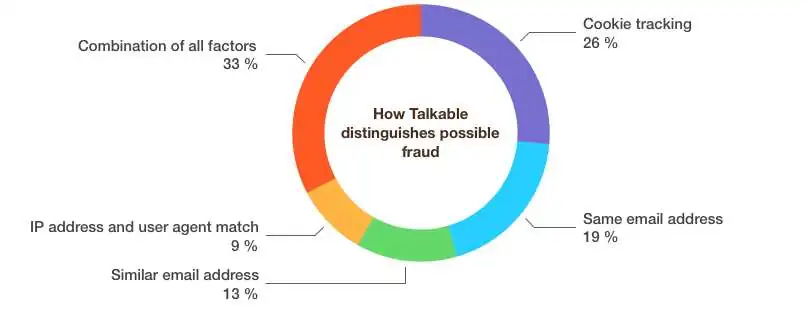
Here are nine methods that work:
1. Verify that advocates are existing customers
Run segmented campaigns that only show the offer to verified past buyers. Talkable checks advocate emails against your customer base and confirms that the referred friend is genuinely new to your business.
2. Track cookies to prevent repeat redemptions
When a first-time visitor hits a campaign page, Talkable generates a unique browser identifier. If the same identifier shows up on the friend claim page, the system flags it as a likely self-referral. This catches people who cycle through the funnel from one device without creating a new account.
3. Use manual approval as a final check
Talkable lets you flag suspicious requests for human review. Your team makes the final call on whether an advocate receives their reward. It costs time, but it's worth it for high-value programs where accuracy matters more than speed.
The right fraud settings depend on your program's volume. High-volume programs need automation. High-value programs may warrant manual approval for flagged cases.
Whether manual approval makes sense depends on your program's volume. If you're processing thousands of referrals a month, automation should handle most of it — manual review only for the flagged edge cases.
4. Monitor IP addresses
Multiple transactions from the same IP aren't automatically fraud. Coworkers sharing an office or family members at home can look suspicious. But flagging repeated attempts from the same IP lets your team investigate when something looks off. Talkable lets you configure this as a flag rather than a hard block.
5. Set the right referral rules for your campaign
Talkable's fraud controls let you skip, flag, or block actions based on patterns you define. Two useful rules:
Similar email match
If someone uses jane.doe@gmail.com and later jane.doe123@yahoo.com, the system can flag or block them automatically.
Physical address match
Multiple customers shipping to the same address can trigger a review. Keep in mind that apartment buildings and dorms have legitimate multi-user addresses, so treat this as a flag rather than an automatic block.
6. Cap how many rewards advocates can earn
Putting a limit on how many times someone can collect a referral reward stops bad actors cold. Your top legitimate advocates may hit this limit too, so consider giving your best referrers access to a separate, uncapped campaign designed specifically for them.
7. Use coupon codes
Coupons are easy to monitor, revoke, and expire. You can also attach conditions like minimum order values, which reduces the incentive for someone to create a fake account just to grab a small discount. Talkable also supports reward delivery through Apple and Google Wallet passes, which adds another layer of control over how and when rewards are issued.
8. Delay reward delivery
Waiting a day or two before sending out rewards reduces fraud. People gaming the system are usually looking for instant results — a delay filters out opportunists who aren't willing to wait.
9. Use a platform built for fraud prevention
Not all referral platforms treat fraud prevention as a core feature. Talkable's quality control engine handles cookie matching, IP monitoring, email similarity checks, and address matching automatically. For the full documentation on how it works, see our referral approval guide.
The right combination of rules depends on your program's volume and risk tolerance. Start with cookie tracking and email similarity rules — they catch the most common fraud patterns with minimal friction for legitimate customers.