

















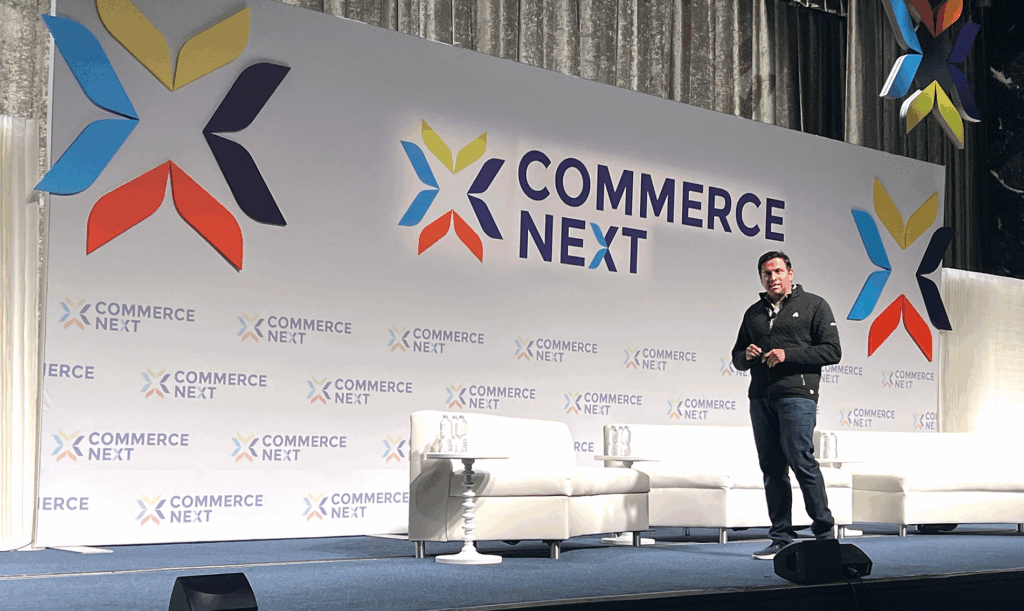
It was 100 degrees in New York City, and the air conditioning at the Hilton was working overtime to keep up with a few thousand of us packed into CommerceNext. Between iced coffees, hallway catch-ups, and dodging the heat wave on 6th Avenue, we actually learned a lot. Real conversations. Sharp takes. No filler.
The best part was trading ideas with people actively shaping the space. Debating the future of retail media with direct mail experts, exploring personalization frameworks with platform partners, talking loyalty over ramen runs. A lot of what's in this recap came straight out of those real-time exchanges. The tech is moving fast, but the sharpest strategies are still grounded in collaboration and a willingness to say "I don't know yet."
What stood out this year wasn't hype. It was clarity. Here's what I took away.
AI as a business tool, finally
AI stopped being the opening slide this year and became the operating assumption. Nearly every session touched on how it's reshaping the customer journey, from product recommendations to post-purchase follow-up. The consistent message: use it with intention. Define the job it's doing. Measure it accordingly. Don't plug it in and hope.
Chatbots are getting genuinely smarter. Personalization is becoming predictive rather than reactive. But the most grounded teams are pairing automation with human oversight. The goal isn't replacing people; it's giving smaller teams leverage to do more with what they have.
The AI-to-AI commerce question
One theme I kept coming back to: AI-to-AI commerce. We're approaching a point where a customer's shopping assistant talks directly to a retailer's recommendation algorithm to finalize a purchase. That's not science fiction anymore; it's closer to an engineering roadmap item. The implication is that product data, descriptions, and pricing logic now need to be optimized for machines making decisions on someone's behalf, not just for humans browsing a grid.
"Don't ask what AI can do. Ask what job needs doing, then figure out if AI is the right tool for that job. Plenty of teams got that backwards this year."
Personalization as infrastructure
Personalization used to be a nice-to-have. Now it's a baseline expectation. Consumers want relevant experiences across all touchpoints, and they notice when they don't get them. The teams doing this well have moved well past demographic segments into behavior-driven, real-time adaptation.
It starts with clean, unified data. One retailer shared how syncing quiz responses, purchase history, and customer service logs gave them a 360-degree customer view they could actually act on, rather than just admire in a dashboard. If your systems don't talk to each other, you're not personalizing. You're guessing with extra steps.
Zero-party data is worth the work
We also spent real time on zero-party data. Customers are willing to share preferences when they get something useful in return. Interactive tools like quiz flows, preference centers, and onboarding surveys are becoming standard practice for earning that data in a privacy-compliant way. Brands that have this dialed in are seeing higher email engagement and better conversion on their referral programs because the offers they serve actually match what people want.
Privacy as a product feature
The end of third-party cookies isn't news anymore. What matters now is the response. First-party and zero-party data are the growth assets. And transparency is increasingly the differentiator between brands people trust and brands people tolerate.
Consumers want control over how their data is used. The brands that explain why they collect it and what they do with it are building something valuable. One line stuck with me from a session: "Privacy is a feature, not a compliance task." That landed because it's true, and most companies are still treating it like the latter.
More teams are leaning into contextual targeting, owned channels, and explicit value exchange. This isn't a step backward in capability. It's a reset that rewards creative thinking and brand equity over brute-force targeting.
1000+ ecommerce brands use Talkable to run referral programs that drive measurable revenue. We can show you real benchmarks from brands in your vertical.
Let's TalkOmnichannel on the ground
CommerceNext made one thing concrete: the line between online and offline is gone for the customer, even if it still exists inside most org charts. Customers expect every touchpoint to feel connected. They don't experience channels; they experience brands.
Wallet passes came up more than I expected. We had good conversations with partners about how Apple and Google Wallet passes are becoming a practical extension of the CRM, putting loyalty hooks, referral moments, and brand offers directly into a shopper's native device interface without requiring an app download. Geo-triggered rewards, in-store referral prompts, real-world loyalty check-ins. The connective tissue between ecommerce and physical retail.
The in-store and online teams need to actually talk
Beyond tech, the organizational question came up too. One brand's store associates use iPads to see a customer's online browsing behavior before stepping in to help. Another brand lets customers unlock exclusive digital content after an in-person purchase. These aren't gimmicks; they're friction-removal. Customers don't care which team owns what. They just want it to work.
Real-time inventory visibility, cross-channel returns, and mobile tools that enhance the physical shopping experience are table stakes now. Brands that still treat the website and the store as separate businesses are going to keep losing customers at the handoff.
Retail media and the acquisition math
CAC continues to climb. That's been true for three years and shows no signs of reversing. What's changing is where the smart money is looking for growth.
Retail media networks were everywhere in the conversation. The appeal is clear: high-intent shoppers, on-platform, already in a buying mindset. But the brands getting real returns from it are investing in measurement infrastructure first. Without clean attribution, retail media spend is just expensive hope.
Influencer marketing got a reality check too. Performance matters more than follower count now. Creators who genuinely use and like the product outperform paid endorsements reliably. That's not a new lesson, but it's one the industry keeps relearning. Our case studies show a similar pattern with referral: authenticity from a real customer consistently beats a polished campaign from a stranger.
"Authenticity isn't a vibe. It's a conversion rate. The more a creator or customer actually believes what they're saying, the more the person on the other end can tell."
The takeaway
We're past the age of shiny tools. We're in the age of operational excellence. AI, personalization, privacy, and omnichannel aren't separate initiatives you resource and track independently. They're interconnected parts of how a brand shows up for its customers, consistently, across every touchpoint.
CommerceNext gave me more than ideas. It gave me a clearer sense of which brands are actually executing versus which ones are still workshopping strategy decks. The gap is widening. The brands acting on these shifts now will be in a different position by Q4.
Let's get to work.
About the author
Jeremy Foreshew is Head of Marketing at Talkable, where he helps DTC and ecommerce brands turn their customers into their most powerful acquisition channel. He writes about referral strategy, retention, and word-of-mouth marketing. His work has been featured in Forbes, TechCrunch, and HuffPost.